Archives
- 2026-06
- 2026-05
- 2026-04
- 2026-03
- 2026-02
- 2026-01
- 2025-12
- 2025-11
- 2025-10
- 2025-09
- 2025-03
- 2025-02
- 2025-01
- 2024-12
- 2024-11
- 2024-10
- 2024-09
- 2024-08
- 2024-07
- 2024-06
- 2024-05
- 2024-04
- 2024-03
- 2024-02
- 2024-01
- 2023-12
- 2023-11
- 2023-10
- 2023-09
- 2023-08
- 2023-07
- 2023-06
- 2023-05
- 2023-04
- 2023-03
- 2023-02
- 2023-01
- 2022-12
- 2022-11
- 2022-10
- 2022-09
- 2022-08
- 2022-07
- 2022-06
- 2022-05
- 2022-04
- 2022-03
- 2022-02
- 2022-01
- 2021-12
- 2021-11
- 2021-10
- 2021-09
- 2021-08
- 2021-07
- 2021-06
- 2021-05
- 2021-04
- 2021-03
- 2021-02
- 2021-01
- 2020-12
- 2020-11
- 2020-10
- 2020-09
- 2020-08
- 2020-07
- 2020-06
- 2020-05
- 2020-04
- 2020-03
- 2020-02
- 2020-01
- 2019-12
- 2019-11
- 2019-10
- 2019-09
- 2019-08
- 2019-07
- 2019-06
- 2018-07
-
The most common adverse events in relation to udenafil treat
2020-08-19
The most common adverse events in relation to udenafil treatment are headache and facial flushing; other possible adverse events are febrile sensation, dyspepsia, and visual disturbances. No severe adverse event related to udenafil has been reported thus far. The adverse event rate recorded in the p
-
br Conclusions ERK and its phosphorylation plays an
2020-08-19

Conclusions ERK 1/2 and its phosphorylation plays an essential role in the hippocampus and can be triggered by both ROS accumulation and excessive Ca2+. DBP exposure can also affect the production of ROS and Ca2+ in the hippocampus. The question therefore arises as to whether the cell injury or a
-
br The ubiquitin proteasome system The ubiquitin proteasome
2020-08-18
The ubiquitin proteasome system The ubiquitin proteasome system (UPS) plays a significant role in the regulation of cell growth and survival, in addition to maintaining cellular homeostasis. By means of the UPS, Spadin receptor can precisely and temporally degrade approximately 80% of the entire
-
br DGKs bind and regulate
2020-08-18
DGKs bind and regulate other signalling proteins Based on the evidence noted above, DGKs achieve specificity of function through a combination of post-translational modifications, the availability of cofactors, and through the availability and access to substrate DAG. DGKs appear to achieve an ad
-
With the recent expanse of
2020-08-18
With the recent expanse of technology to evaluate synthetic lethality, new combinations with DHODH inhibitors may be uncovered (O\'Neil, Bailey, & Hieter, 2017). Many oncogenic backgrounds share synthetic lethality with DHODH. Cells with mutant PTEN have increased glutamine metabolism and are sensit
-
Interestingly genome wide association studies have linked th
2020-08-18
Interestingly, genome-wide association studies have linked the chromosomal region harboring RDHE2 (SDR16C5) and seven other genes to stature and growth in cattle, humans, and pigs [30], [31], [32], [33], [34], [35], [36], [37], and beak deformity in chickens [38]. The most recent study specifically
-
Kluveromyces lactisSimilar to S cerevisiae K lactis is a fac
2020-08-18
Kluveromyces lactisSimilar to S. cerevisiae, K. lactis is a facultative anaerobic respiratory yeast, which lacks Complex I in its mitochondrial respiratory chain. However, both yeasts differ regarding their respiratory-fermentative metabolism as K. lactis exhibits a greater use of the pentose phosph
-
br Acknowledgements br Introduction Chemokines are a
2020-08-18
Acknowledgements Introduction Chemokines are a superfamily of chemotactic cytokines that play important roles in regulating cell migration and activation under inflammatory conditions (Nomiyama et al., 2008; Peatman and Liu, 2007; Zlotnik and Yoshie, 2000), such as angiogenesis (Arenberg et al
-
TG4-155 sale Allele specific methylation has been
2020-08-18
Allele-specific methylation has been observed in CpG islands of imprinted genes.27, 32 In the present study, however, methylation of CpG1 was specific to ALL TG4-155 sale and occurred in the leukemia cells of 28% of children with ALL, but it was not found in normal leukocytes from the same patients.
-
br Introduction br Conclusion br
2020-08-18
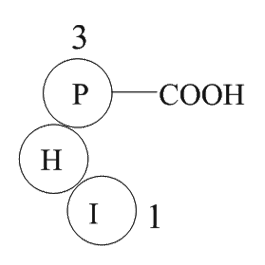
Introduction Conclusion Acknowledgments and Funding Introduction Reversible protein phosphorylation is an important post-translational modification of proteins regulating many processes in the cell. Approximately one third of the cellular proteome is phosphorylated, and several sites are
-
The repeat sequence TTAGGG of telomere
2020-08-18
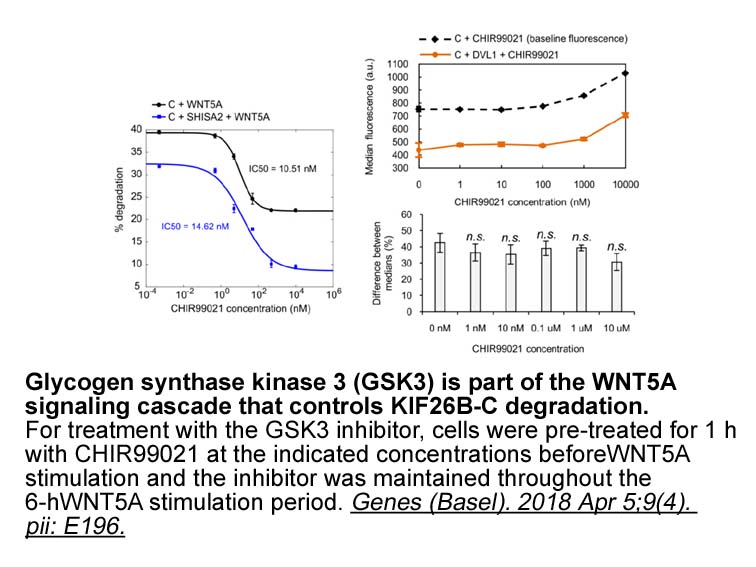
The repeat sequence “TTAGGG” of telomere could be directly recognized by TERF1. TERF1 is indispensable for the maintenance of telomere Akt Inhibitor IV structure and integrity (Tan et al., 2017). Trf1 genetic depletion in vivo induces a persistent DNA damage response and telomere uncapping, which e
-
LY-2228820 br Introduction Myotonic dystrophy dystrophia myo
2020-08-18
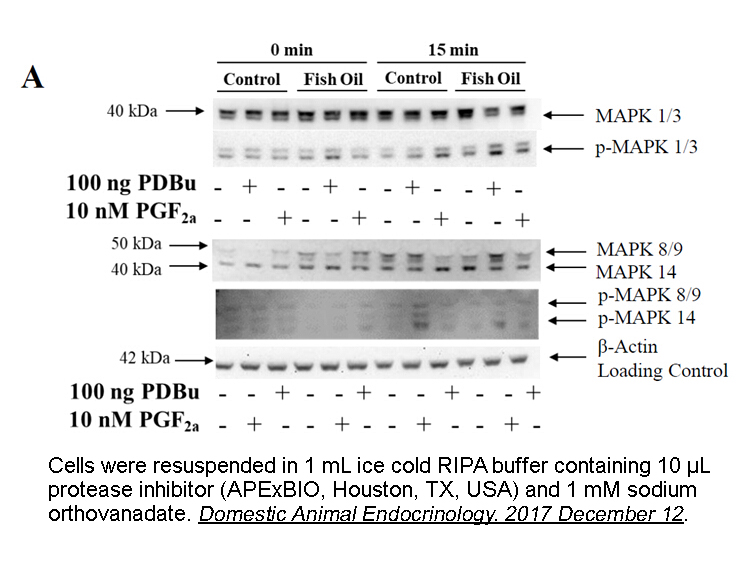
Introduction Myotonic dystrophy (dystrophia myotonica, DM) is an autosomal dominant disorder and the most common form of inherited muscular dystrophy in adults [1]. DM is characterised by a wide range of symptoms, including myotonia, progressive muscle loss, cataracts, cardiac conduction defects,
-
indocid Recent studies have shown that some CLC genes partic
2020-08-18
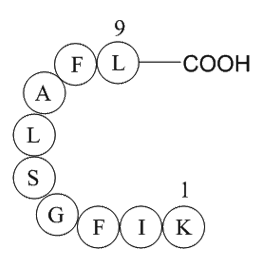
Recent studies have shown that some CLC genes participate in plant salt tolerance and have speculated that they function by mediating Cl− transport across the tonoplast. For instance, AtCLCc, a vacuolar anion transporter, is shown to be involved in the regulation of stomatal movement and to contribu
-
In conclusion we have found that Egr can play an
2020-08-17
In conclusion, we have found that Egr1 can play an inhibitory role on DBH promoter-driven transcription. This inhibition requires a newly identified Egr1 response sr9011 at the −227/−224 region of DBH promoter. This inhibition appears to result from Egr1 directly bound to the DBH promoter. We specul
-
Novobiocin Sodium australia Three DDR binding sites have
2020-08-17

Three DDR2 binding sites have been mapped on the collagen triple helix by us for collagen type 1 and by others using the collagen toolkit for collagen type 2. All of the three reported binding sequences are conserved in the α1 chain of collagen types 1, 2 and 3. The central motif sequence GARGQAGVMG
15705 records 846/1047 page Previous Next First page 上5页 846847848849850 下5页 Last page